The best Autosana alternatives are Maestro (free and open source), Drizz ($49 a month, free trial with 300 tokens), Momentic (free plan with $50 of usage a month), Revyl (up to 1,200 free device minutes a month), TestChimp, QA Wolf and BrowserStack App Automate. Autosana starts free with up to 1,000 AI actions a month. Checked November 23, 2026.
 Autosana on Toolfolio. Updated November 23, 2026.
What is Autosana and how does it work?
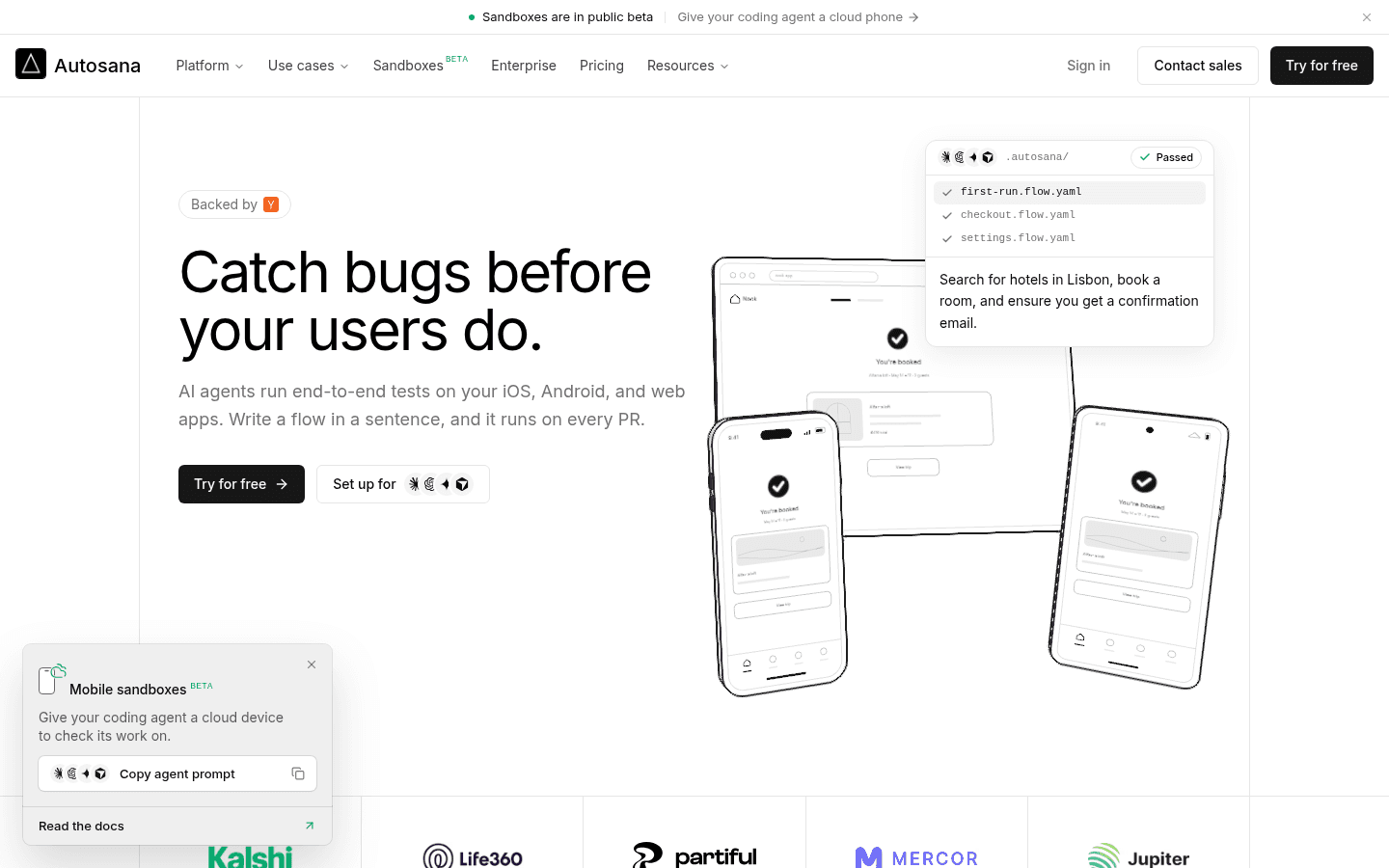
Autosana is an AI QA agent that runs end-to-end tests on iOS, Android and web apps. It is a Y Combinator company from the Summer 2025 batch, based in San Francisco. Instead of writing scripts with selectors, you describe a user journey in a sentence, such as "Add a hoodie to the bag, check out with the saved card and confirm the order shows a $24 total", and an AI agent taps through your app like a person would.
Here is how a typical Autosana setup works:
- Add your app. Upload an iOS (.app) or Android (.apk) build, or enter a website URL.
- Write flows in plain English. Flows can live in the dashboard or as YAML files in your repo (Autosana calls these code-managed flows).
- Run them locally or in the cloud. The CLI runs flows on your own simulator, emulator or browser, and the cloud runs them on hosted devices.
- Test every pull request. A GitHub PR bot runs the flows your change touches and posts results and videos on the PR.
Autosana is built to work with coding agents. Its MCP server connects to  Claude Code,
 Cursor,
 Codex, Gemini CLI, Devin and others, so your agent can write a flow, run it, fix what fails and run it again before it opens a PR. When the UI changes, flows adapt as long as the user journey still works, so you are not rewriting broken selectors.
How much does Autosana cost?
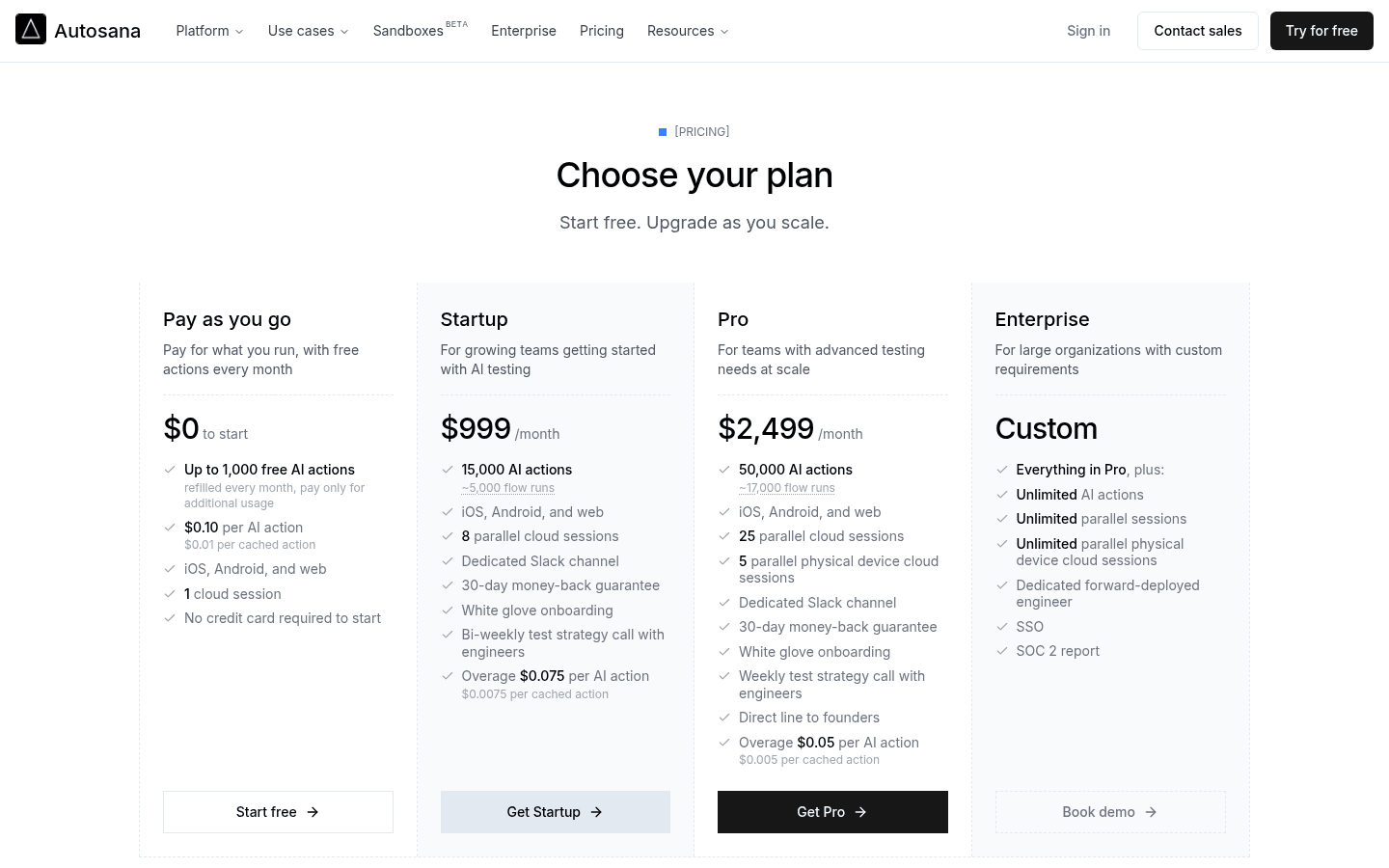
Autosana has four plans on its pricing page. The free tier is generous for a solo developer, but the first paid plan jumps straight to $999 a month.
| Plan | Price | AI actions included | Overage | Cloud sessions at once |
|---|---|---|---|---|
| Pay as you go | $0 to start | Up to 1,000 free a month | $0.10 per action, $0.01 cached | 1 |
| Startup | $999 a month | 15,000 (about 5,000 flow runs) | $0.075 per action, $0.0075 cached | 8 |
| Pro | $2,499 a month | 50,000 (about 17,000 flow runs) | $0.05 per action, $0.005 cached | 25, plus 5 on physical devices |
| Enterprise | Custom | Unlimited | Custom | Unlimited |
What counts as an AI action?
An AI action is each step the agent takes in your app, like a tap, a swipe or typing an email. Autosana's flow run estimates assume 15 actions per flow and an 80% cache rate. Cached actions are steps from passing flows that are replayed, and Autosana says those run 5 to 8 times faster and cost 90% less.
Is Autosana free?
Yes, to start. The Pay as you go plan gives you up to 1,000 free AI actions a month with no credit card. That covers iOS, Android and web, unlimited local runs against your own simulators, and one cloud session at a time. After the free actions, you pay $0.10 per action. At 15 actions per flow and no caching, 1,000 actions is roughly 66 flow runs a month.
Why teams look for an Autosana alternative
- The price gap. There is nothing between the free tier and $999 a month, so a small team that outgrows 1,000 actions either pays per action or jumps to Startup.
- Lock-in. Autosana flows are written for Autosana. If you want tests in an open format like Maestro YAML, Playwright or Appium, you need a different tool.
- Open source. Some teams want a free, self-run framework first and AI on top later.
- Done-for-you QA. Others do not want to write flows at all and prefer a managed service.
Autosana alternatives compared
Autosana is an E2E testing solution designed to help teams ship quality software faster by integrating testing with coding agents for mobile and web apps.
None of these alternatives are listed on Toolfolio yet, so they are linked to their own sites. All prices come from each tool's public pricing page.
| Tool | Best for | Free option | Paid from | Pricing model | Platforms |
|---|---|---|---|---|---|
| Autosana | AI agent tests that loop with your coding agent | Up to 1,000 AI actions a month | $999 a month | Per AI action | iOS, Android, web |
| Maestro | Free, open source mobile UI testing | Free and open source (local) | $250 per device a month (Cloud) | Per concurrent device | Android, iOS, web |
| Drizz | Solo developers and small mobile teams | Trial: 300 tokens (about 30 runs) | $49 a month | Per executed step | Mobile apps |
| Momentic | Web and mobile teams who want a usage budget | $50 of usage a month | $500 a month | Usage (per step and per minute) | Web, iOS, Android |
| Revyl | Pay per device minute | Up to 1,200 device minutes a month | $0.075 a minute (iOS and Android) | Per device minute | iOS, Android, web, macOS |
| TestChimp | Agent-driven teams that want QA planning and governance | 14-day trial, no card | $42 a month billed yearly | Per plan plus credits | Web and mobile |
| QA Wolf | Teams that want unlimited AI and tests in Playwright or Appium | None listed | $1 per web run, $2 per mobile run | Per test run | Web, mobile, desktop |
| BrowserStack App Automate | Running existing scripts on real devices | Free trial | $199 a month billed yearly | Per parallel test | Real iOS and Android devices |
The best Autosana alternatives in 2026
1. Maestro: the free, open source alternative
Maestro is an open source framework for end-to-end UI testing on mobile and web, released under the Apache 2.0 license with about 16,500 stars on GitHub. You write flows in simple YAML, and Maestro Studio, the CLI, Maestro MCP and Maestro Viewer are all free to run locally on your own devices. The pricing page also lists "self-healing with local agents" on the free tier.
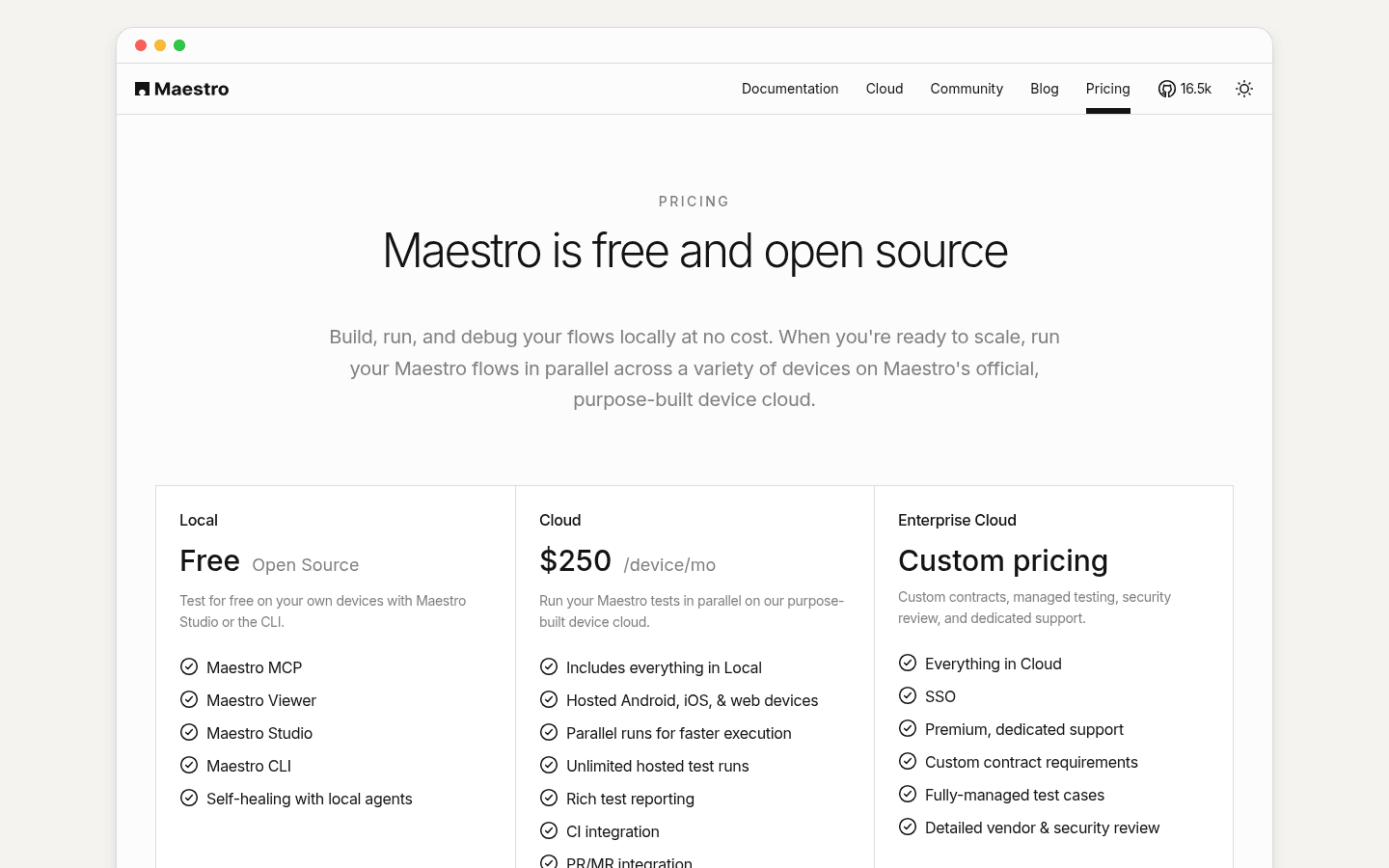
- Free: everything local, forever.
- Cloud: $250 per device a month, with parallel runs on hosted Android, iOS and web devices, unlimited hosted test runs, CI and PR integration. There is a free cloud trial.
- Enterprise Cloud: custom, with SSO and fully managed test cases.
Maestro is what Autosana is most often compared with. One Autosana customer quote on its homepage says the team was "spending so much time maintaining Maestro tests" before switching. The trade off is clear: Maestro costs nothing and keeps your tests in an open format, but you write and maintain the steps yourself, while Autosana's agent figures out the steps from a sentence.
2. Drizz: the cheapest paid AI testing plan
Drizz is an AI testing tool for mobile apps that charges only for test runs. Writing and editing tests never costs anything, and one Drizz Token pays for one executed step.
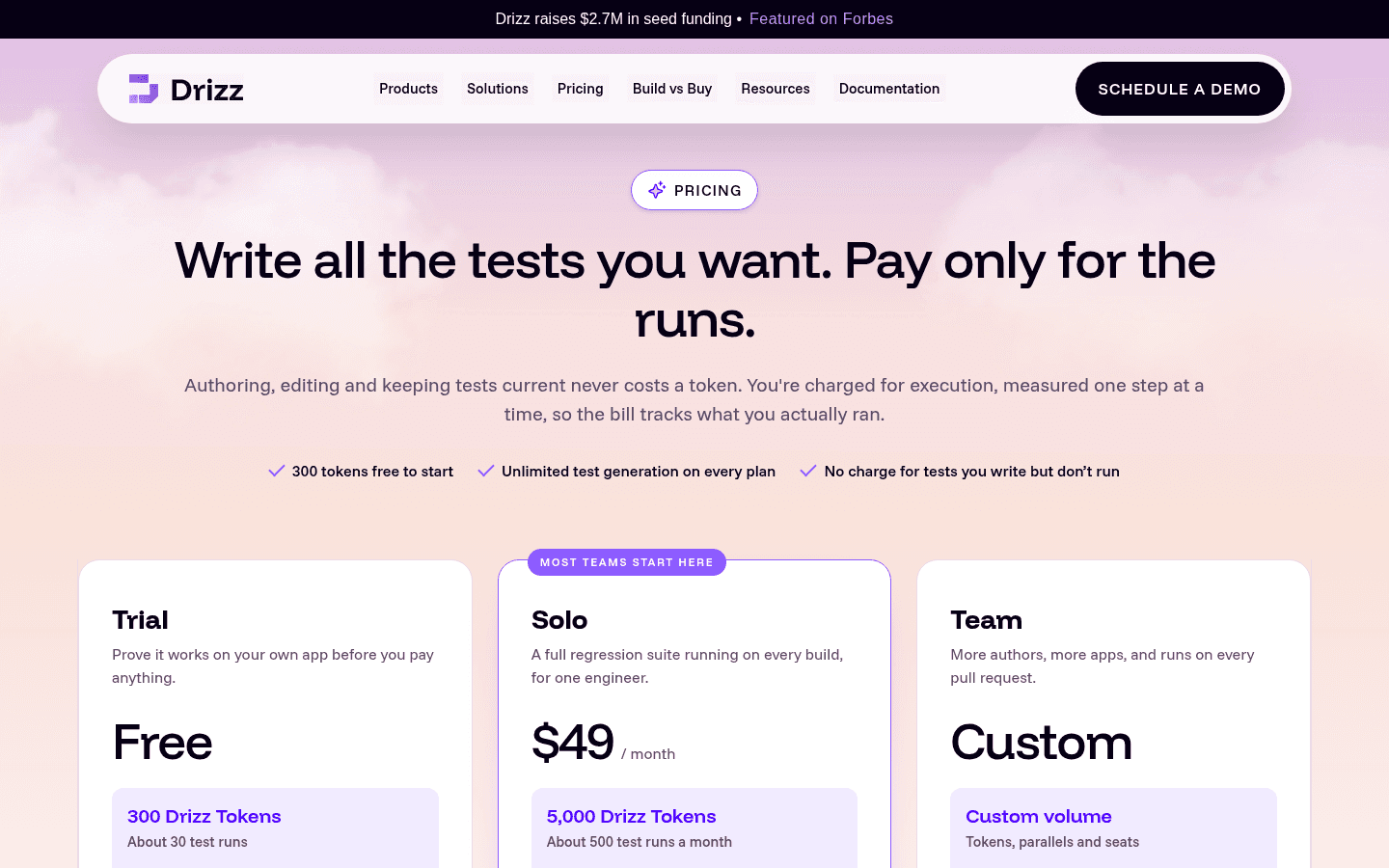
| Plan | Price | Tokens | About this many 10-step runs | Apps and seats |
|---|---|---|---|---|
| Trial | Free | 300 | 30 | 1 app, 1 seat |
| Solo | $49 a month | 5,000 a month | 500 | 2 apps, 1 seat, 1 parallel run |
| Team | Custom | Custom | Custom | Custom |
Failed runs still use tokens, and runs stop when you hit zero until you top up. For a solo developer, Drizz Solo is the cheapest paid AI testing plan in this list by a wide margin.
3. Momentic: a free plan with $50 of usage
Momentic is an agentic testing platform for web, iOS and Android, with a CLI, an MCP server and an AI QA engineer called Mo that bug bashes your app. Tests can mix AI goals with fixed steps and assertions kept in YAML in your repo.
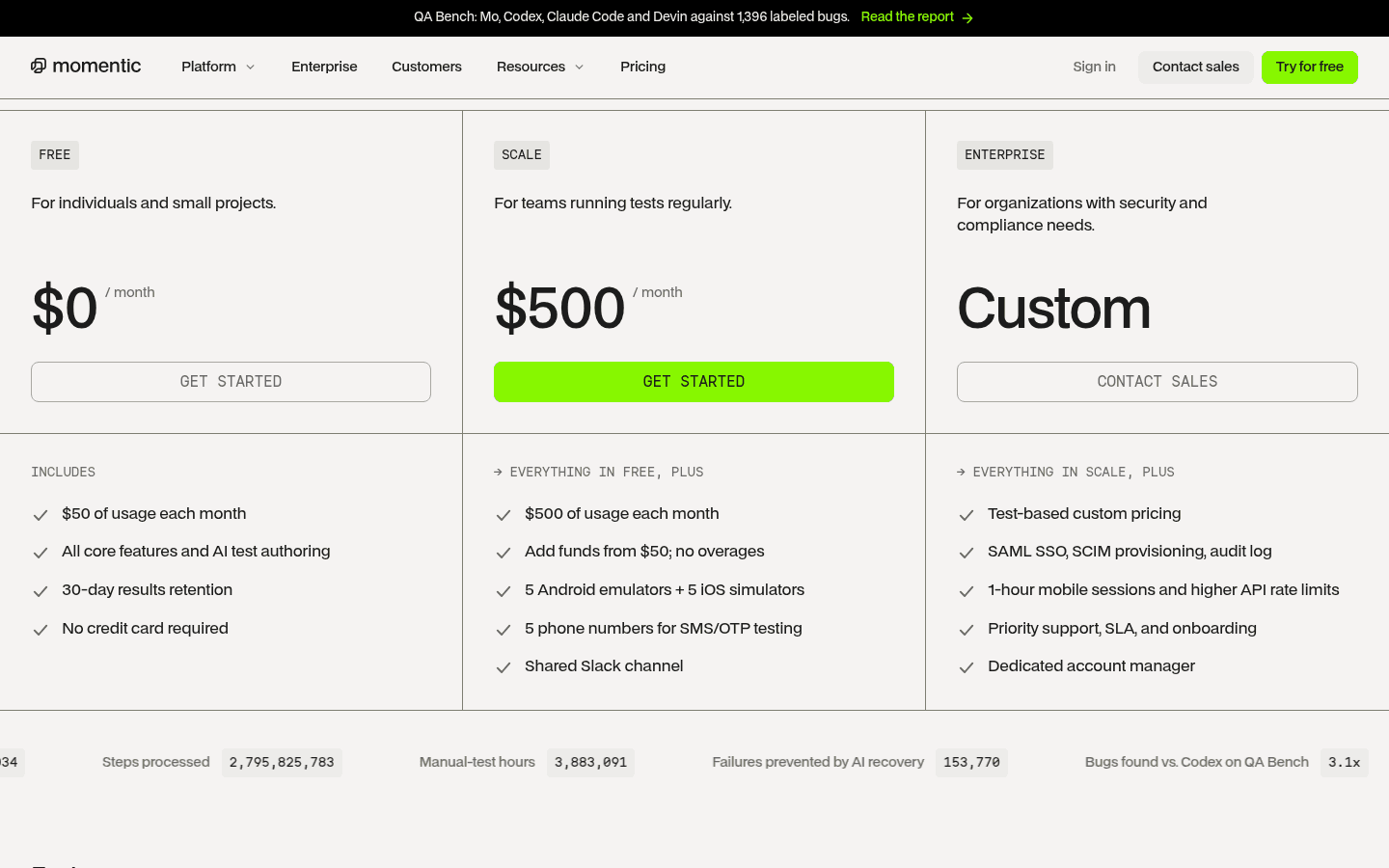
- Free: $0 a month with $50 of usage each month, all core features and AI test authoring, 2 Android and 2 iOS sessions at once, 30-day results retention, no credit card.
- Scale: $500 a month with $500 of usage, add funds from $50 (they never expire), 5 Android emulators and 5 iOS simulators.
- Enterprise: custom, test-based pricing with SSO and SCIM.
Usage is metered. A test step costs $0.0125, an AI-generated or failure-recovery step costs $0.025, a hosted browser costs $0.005 a minute, an Android emulator $0.10 a minute and an iOS simulator $0.1875 a minute. There are no overages: runs pause when your balance reaches $0.
4. Revyl: up to 1,200 free device minutes a month
Revyl gives you cloud devices for building, running and verifying changes on iOS, Android, web and macOS, with a CLI, API and CI integrations. It bills by the device minute rather than by AI step.
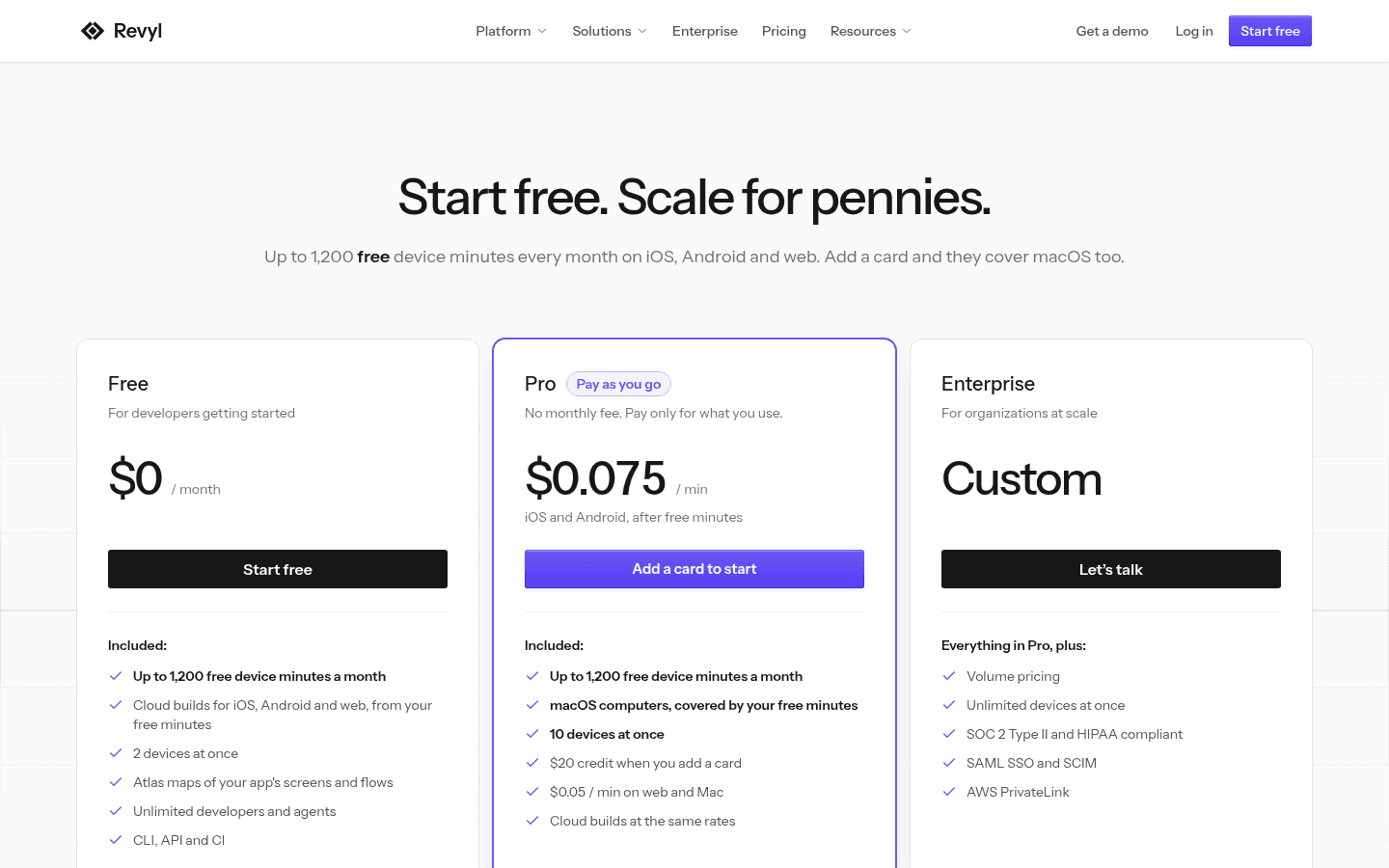
- Free: up to 1,200 device minutes a month on iOS, Android and web, 2 devices at once, unlimited developers and agents.
- Pro (pay as you go): no monthly fee. $0.075 a minute on iOS and Android, $0.05 a minute on web and macOS, 10 devices at once. Adding a card charges $20 of credit, and your 1,200 free minutes still apply.
- Enterprise: custom, with SOC 2 Type II, HIPAA, SSO and dedicated iOS runners.
If your tests are short, minute billing can be much cheaper than per-step pricing. An hour of iOS device time on Pro is $4.50.
5. TestChimp: QA planning and governance for agent-driven teams
TestChimp pitches itself as "release confidence for agent-driven teams". It keeps test plans and tests in your repo, measures coverage, runs UX checks, and has an agent called ChimpHands that does QA work for you on credits. TestChimp also publishes its own Autosana comparison guide, which shows it is targeting the same buyers.
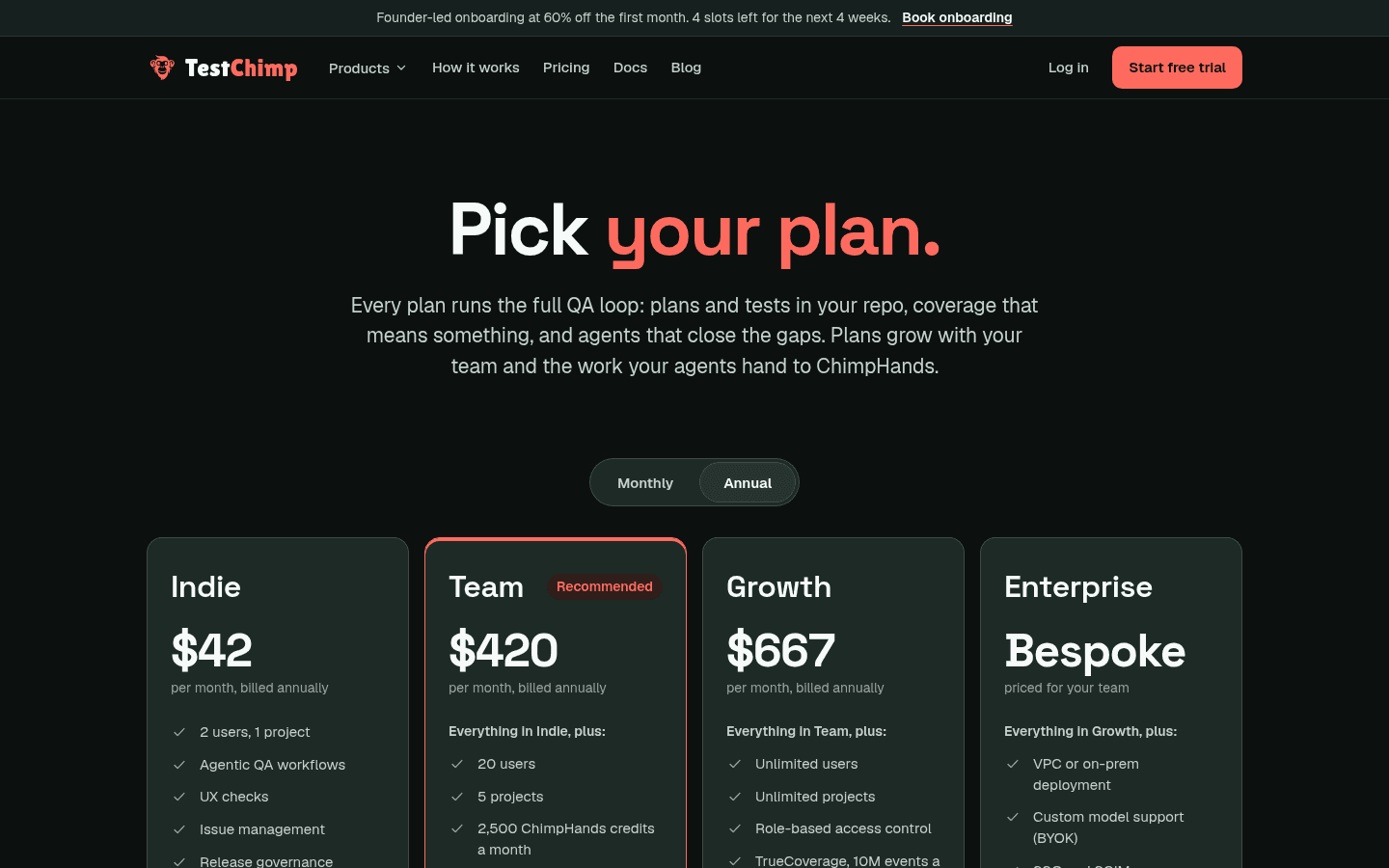
| Plan | Billed yearly | Billed monthly | Users and projects | ChimpHands credits a month |
|---|---|---|---|---|
| Indie | $42 a month ($500 a year) | $50 a month | 2 users, 1 project | 250 |
| Team | $420 a month | $500 a month | 20 users, 5 projects | 2,500 |
| Growth | $667 a month | $800 a month | Unlimited | 8,000 |
| Enterprise | Bespoke | Bespoke | Unlimited, VPC or on-prem | Custom |
Extra ChimpHands work is $0.01 a credit. Every plan has a 14-day free trial with no credit card, but there is no permanent free plan.
6. QA Wolf: pay per test run with unlimited AI
QA Wolf charges a flat price per test run, with unlimited AI usage, full parallelization and no user limits. Its agents plan coverage, write tests in open source Playwright and Appium, pick which tests each PR needs, investigate failures, repair broken tests and file bugs in Linear or Jira.
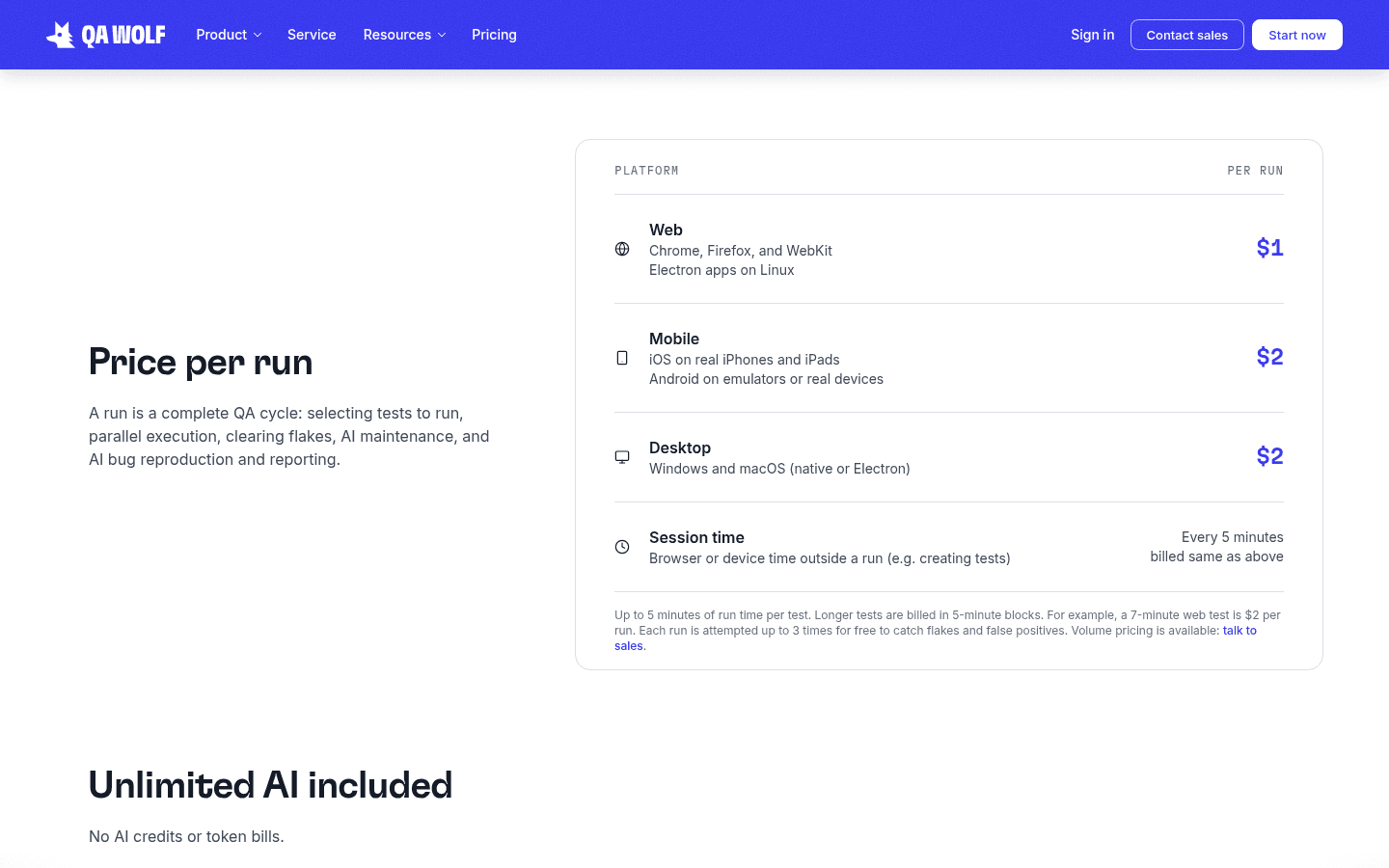
| Platform | Price per run |
|---|---|
| Web (Chrome, Firefox, WebKit, Electron on Linux) | $1 |
| Mobile (iOS on real iPhones and iPads, Android on emulators or real devices) | $2 |
| Desktop (Windows and macOS) | $2 |
A run covers up to 5 minutes per test, and longer tests are billed in 5-minute blocks. Each run gets up to 3 free attempts to rule out flakes. The big difference from Autosana: your tests are standard Playwright and Appium code, so you can take them with you.
7. BrowserStack App Automate: real devices for scripts you already have
BrowserStack App Automate is not an AI agent you describe tests to. It is a cloud of more than 30,000 real iOS and Android devices that runs your existing Appium, Espresso, XCUITest, Maestro or Flutter tests. Its AI features (a self-healing agent, test failure analysis and a test selection agent) are on the Pro plan.
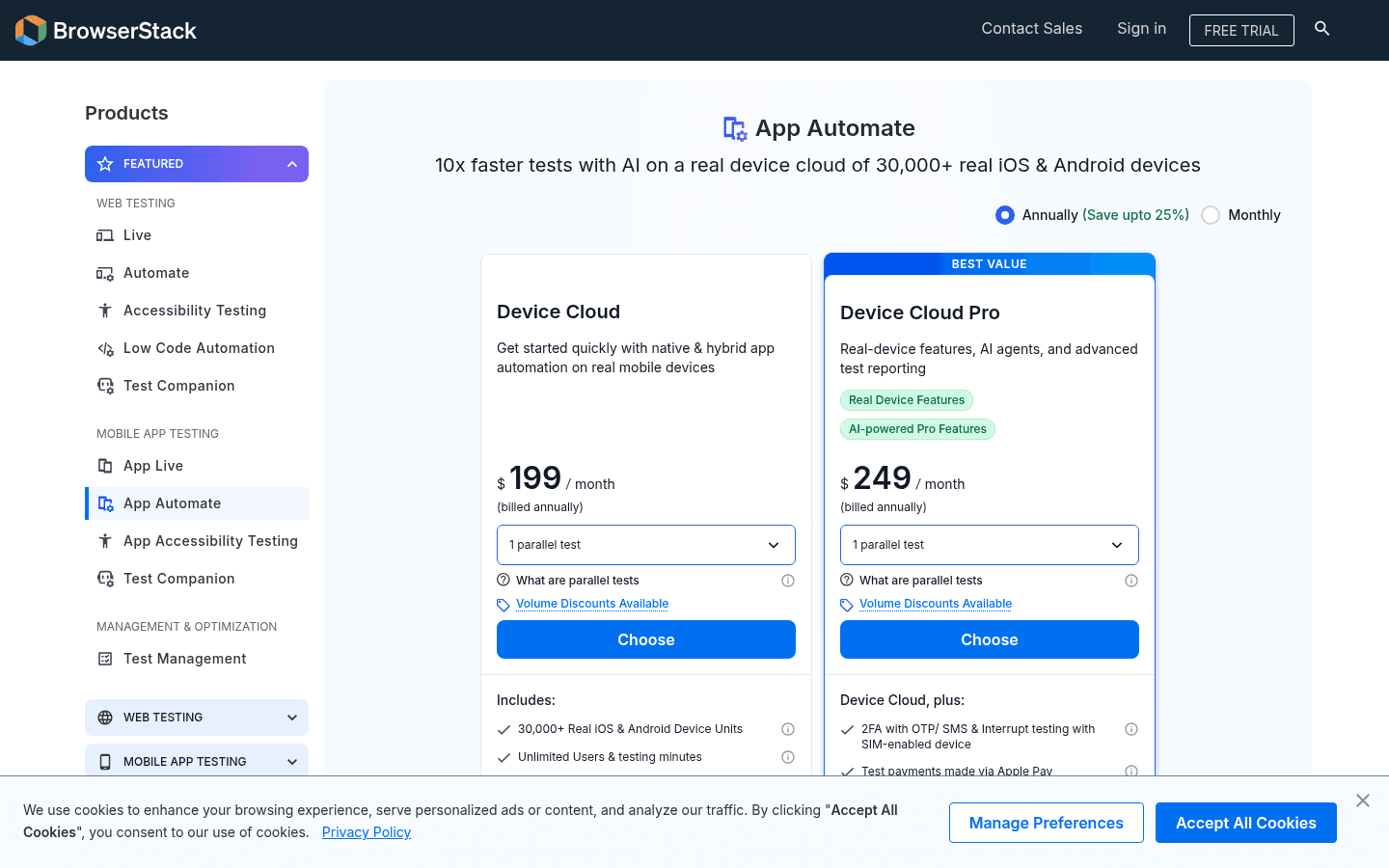
- Device Cloud: $199 a month billed yearly for 1 parallel test, with unlimited users and testing minutes.
- Device Cloud Pro: $249 a month billed yearly, adding SIM-enabled 2FA and SMS testing, Apple Pay, frontend performance testing and the AI agents.
- Free trial: available from the BrowserStack site.
Pick it if you already have Maestro or Appium tests and need real hardware, not emulators.
How to choose the right Autosana alternative
Cost of one 10-step test run
Pricing models differ so much that the easiest way to compare is one small test. These are rough list prices for a 10-step mobile test that takes about 2 minutes, before any free allowance or volume discount.
| Tool | How it is billed | Rough cost per run |
|---|---|---|
| Autosana (pay as you go) | 10 AI actions at $0.10, or $0.01 when cached | $1.00 new, $0.10 cached |
| Drizz Solo | 10 tokens out of 5,000 for $49 | About $0.10 |
| Momentic | 10 steps at $0.0125 plus 2 minutes of iOS simulator at $0.1875 | About $0.50 (more if AI steps are used) |
| Revyl Pro | 2 device minutes at $0.075 | About $0.15 |
| QA Wolf | Flat price per mobile run | $2.00 |
| Maestro (local) | Runs on your own machine | $0 |
These numbers are estimates from public rates, not quotes. Real costs depend on caching, retries, AI recovery steps and how long your app takes to load.
Quick picks
- You want free and open source: Maestro.
- You are a solo developer on a budget: Drizz Solo at $49 a month, or stay on Autosana's free 1,000 actions.
- You want a permanent free tier with AI: Momentic Free ($50 of usage a month) or Revyl Free (up to 1,200 device minutes).
- You want tests in Playwright or Appium you can keep: QA Wolf.
- You already have scripts and need real devices: BrowserStack App Automate.
- You build with coding agents and want them to test their own work: Autosana is still the most direct fit, and Momentic, Drizz and Maestro also offer MCP servers.
If you are building a mobile app with AI tools like 
Frequently asked questions
How does Autosana work?
You upload an iOS or Android build or enter a website URL, then describe a test in plain English. An AI agent runs that journey on a simulator, emulator, browser or cloud device, records every step with screenshots and video, and reports what passed or broke. Flows can live in your repo and run on every pull request.
How much does Autosana cost?
Autosana starts free with up to 1,000 AI actions a month and no credit card. After that, pay as you go is $0.10 per AI action ($0.01 cached). Startup is $999 a month for 15,000 actions, Pro is $2,499 a month for 50,000 actions, and Enterprise is custom.
Does Autosana work with Claude Code?
Yes. Autosana has an MCP server at mcp.autosana.ai. In Claude Code you add it with one command and sign in through your browser. It also connects to Cursor, Codex, Gemini CLI, Devin and Claude Desktop, so your coding agent can write and run tests.
Is Maestro testing free?
Yes. Maestro is free and open source under the Apache 2.0 license. Maestro Studio, the CLI, Maestro MCP and local runs on your own devices cost nothing. Only Maestro Cloud is paid, at $250 per device a month, and it has a free trial.
What are some free mobile testing tools?
Maestro and Appium are free, open source frameworks for mobile UI testing. For AI testing with a free tier, Autosana gives up to 1,000 AI actions a month, Momentic gives $50 of usage a month, Revyl gives up to 1,200 device minutes a month, and Drizz has a free trial with 300 tokens.
Is there an AI agent available for mobile app testing?
Yes. Autosana, Drizz, Momentic, Revyl and TestChimp all use AI agents to run tests on iOS and Android apps from plain-language instructions. QA Wolf uses AI agents to write and maintain Playwright and Appium tests for you, and BrowserStack App Automate Pro adds self-healing and failure analysis agents.
Which AI tool is best for QA testing?
It depends on your budget and stack. For a free start, use Maestro or Momentic's free plan. For a cheap paid plan, Drizz Solo is $49 a month. For tests that loop with a coding agent, Autosana fits best. For portable tests you do not write yourself, QA Wolf charges $1 to $2 per run.
Will QA testers be replaced by AI?
Not fully. AI agents now handle repetitive regression runs and test upkeep, and some vendors report regression time falling from days to about an hour. People are still needed to decide what to test, judge UX problems and own release decisions, which is why tools like TestChimp focus on human review.