treg and Monid are both prepaid, pay-per-call catalogs that give an AI agent thousands of paid tools through one balance. Both start you with $1 of free credit, neither charges a subscription, and both bill at the provider's own rate. The real differences: treg lists 4,200+ endpoints and can also act inside your own connected accounts (Google Ads, Search Console, Slack), while Monid focuses on reading data, takes USDC payments through x402, and publishes its code under the MIT license. We checked every number below on each vendor's own pages on November 19, 2026.
Part of our series on AI agent tool layers. For the wider field, including app-action platforms like Arcade and Nango, read Best Composio alternatives for AI agents.
Disclosure: Toolfolio uses  treg hands-on for keyword research. We are not affiliated with treg or Monid, and we have not run paid calls on a funded Monid account, so the Monid side of this comparison comes from Monid's site, docs, public catalog and GitHub repo.
A quick note on the name: "treg" also means regulatory T cells in immunology. Here it means treg.to, the tool catalog for agents.
What are treg and Monid?
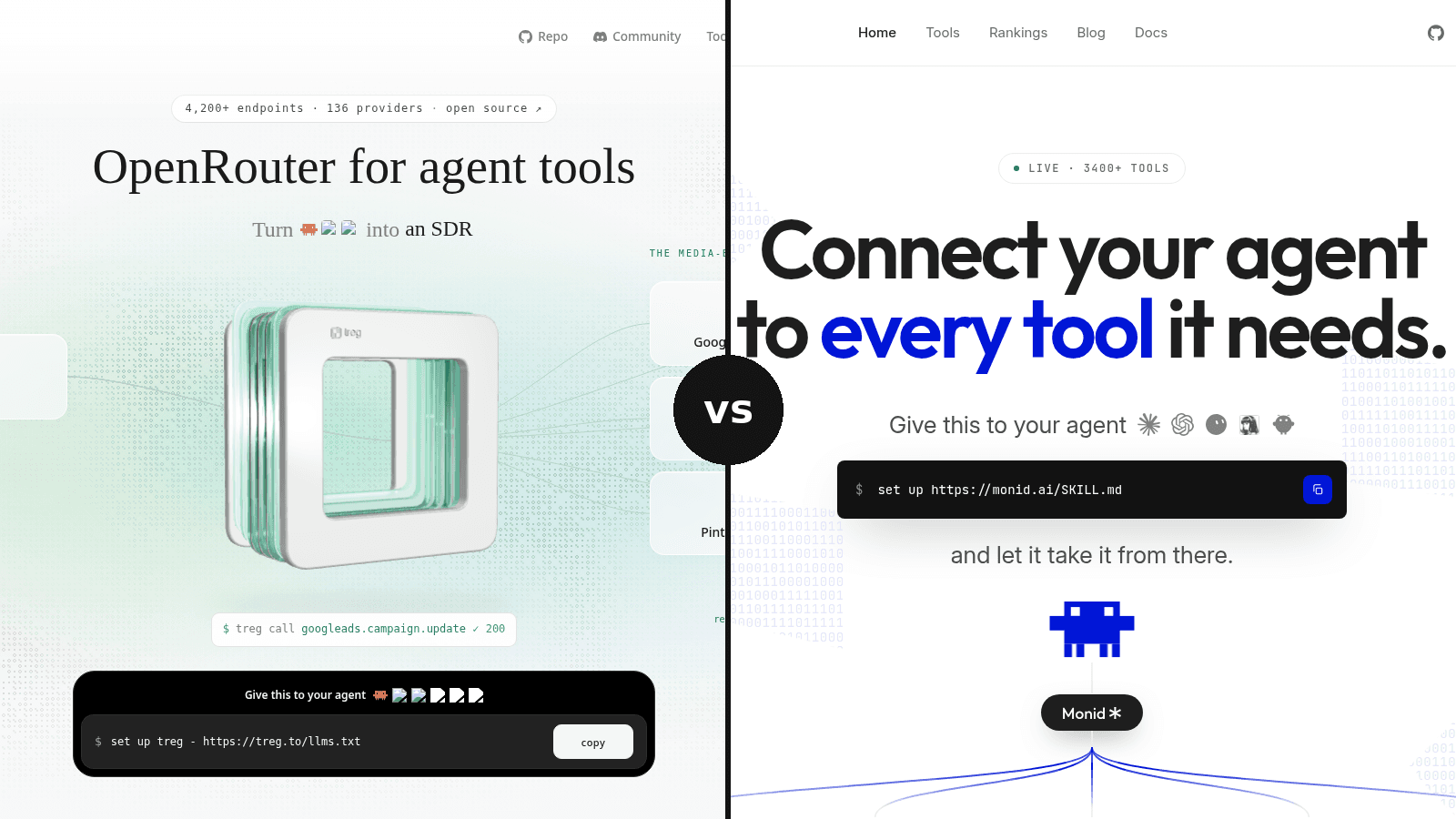
Both pitch themselves as "OpenRouter for agent tools". OpenRouter routes your model calls across providers with one key and one balance. These two do the same for the tool calls an agent makes after it picks a model: web search, scraping, people and company enrichment, social data, SEO data, media generation. Your agent describes the job, gets a ranked list of endpoints with prices, and runs one.
- treg (treg.to) says it has 4,200+ endpoints across 136 providers. Its homepage catalog is built around SEO and SERP data, backlinks, social data, people and company enrichment, ad libraries and campaign management.
 Monid (monid.ai) says it has 3,400+ tools across 105+ providers. Its catalog leans toward scraping, web search, people data, social data across many platforms, finance and on-chain data, plus agent email and phone tools.
They sit in a different lane from app-action platforms such as  Composio, which connect an agent to your users' own accounts. Monid says so itself in its docs: use an action platform like Composio or Zapier to write into SaaS apps, and use Monid for reading and fetching data.
Monid vs treg at a glance
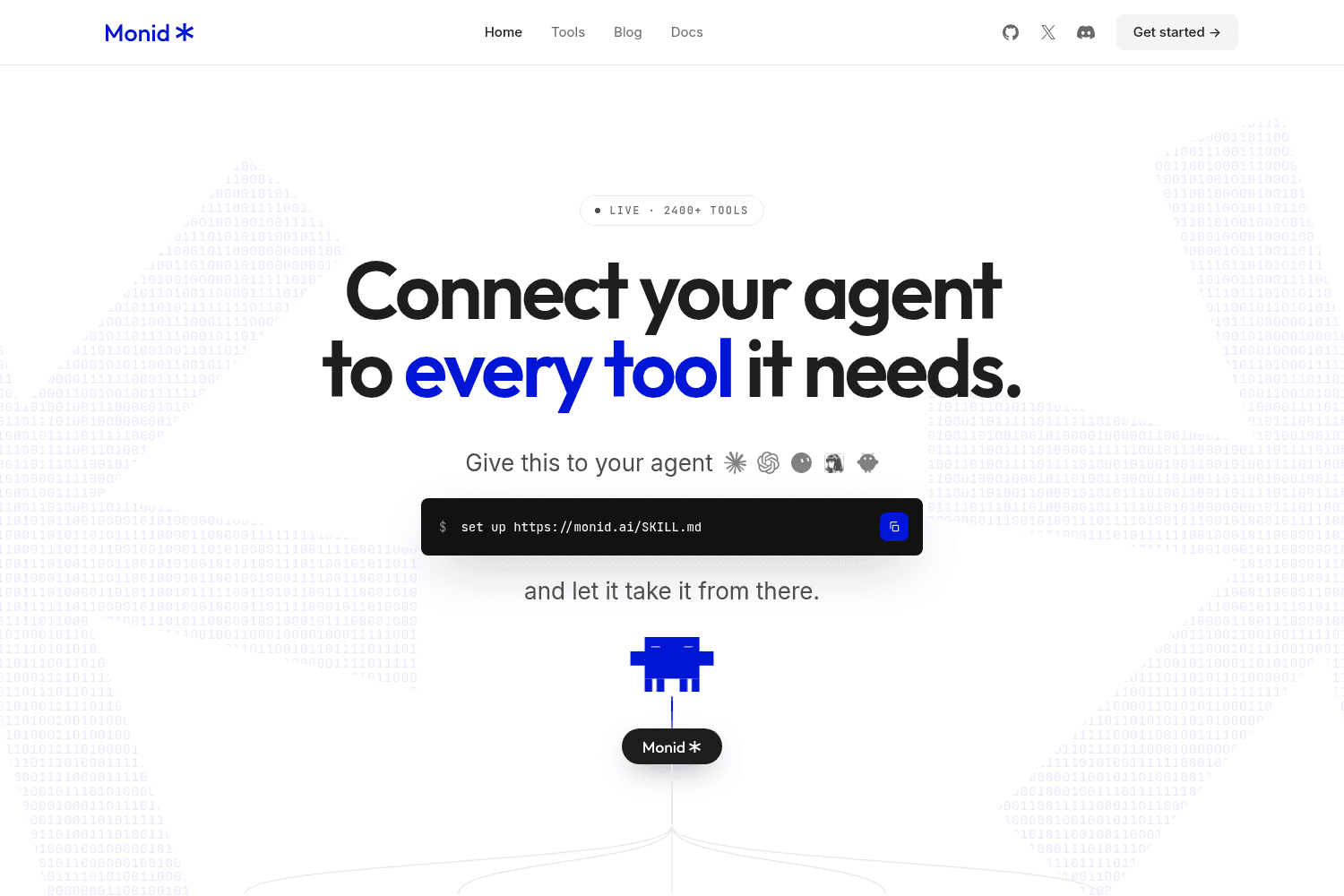

Monid connects your AI agents to a vast library of tools and APIs, allowing seamless integration and utilization. Users can discover, compare, and manage API services efficiently without worrying about subscriptions.
| treg | Monid | |
|---|---|---|
| Catalog size (vendor's words) | 4,200+ endpoints, 136 providers | 3,400+ tools, 105+ providers |
| Strongest at | SEO, SERP, ads, enrichment, social, your own accounts | Scraping, search, enrichment, finance and on-chain, agent email and phone |
| Reads and writes | Reads data and writes in connected accounts | Mostly reads and fetches, plus messaging tools |
| Billing | Prepaid balance, per call, provider's rate | Prepaid balance, per call or per result |
| Markup | 0% on every tool, written into its terms | 0 markup on most endpoints |
| Free credit | $1.00 once per verified account | $1, no card |
| Your own provider keys | Yes, used first and never metered | Not published for the hosted service |
| Crypto and wallet payments | Disputed: see the x402 section | Yes, USDC on Base and Monad through x402 |
| MCP server | https://treg.to/mcp/ | https://mcp.monid.ai/v1 |
| CLI | curl -fsSL https://treg.to/install.sh | sh | npm install -g @monid-ai/cli |
| Code | Apache 2.0 with added terms, about 8,500 GitHub stars | MIT, about 6,200 GitHub stars |
GitHub star counts and licences come from the GitHub API on November 19, 2026. Everything else is from each vendor's own site and docs.
Catalog size and coverage
Both catalogs are large and both change daily, so treat any count as approximate. treg's homepage and llms.txt say 4,200+ endpoints across 136 providers. Monid's pages disagree with each other: its homepage badge and counter show 3,400+ tools across 105+ providers, while its llms.txt still says 2,800+ across 90+, and treg's comparison page (dated November 6) quoted 2,900+. Monid is growing fast, but the 3,400 figure is the newest one we saw.
The overlap is bigger than either vendor admits. Both sell Apollo-style people enrichment, Apify scrapers, Instagram and TikTok data, web search and SEO data. treg's pricing page lists 286 Douyin tools and 192 TikTok tools, so Monid's pitch of covering Chinese platforms that Western vendors skip is not unique to Monid.
Where they differ:
- treg's edge: deep SEO data (its homepage lists Semrush, Moz, SerpApi, DataForSEO, SE Ranking, Majestic, SpyFu and Serpstat among providers), ad libraries and campaign tools for Google, Meta, TikTok, Microsoft, Pinterest and Snapchat, and a long enrichment list (Hunter, Lusha, PDL, Crunchbase).
- Monid's edge: on-chain and DeFi data (QuickNode, DeFiLlama), financial market data, real estate listings, browser automation through Browserbase, and agent phone and email tools (Saperly, AgentMail).
Read vs write: what can the agent actually do?
This is the biggest practical difference.
Monid is a read-and-fetch layer. Its own docs say it calls "APIs and structured scrapers" and that you should use an action platform when you need to write into SaaS apps. Its exceptions are agent messaging: sending SMS, placing calls and agent email.
treg also writes, through accounts you connect. Its homepage shows the agent running a Google Ads campaign update, and says OAuth stays in treg so your agent never holds the token. The listed connections include Google Analytics, Search Console, Google Ads, Business Profile, Meta Ads, TikTok Ads, Microsoft Advertising, Pinterest Ads, Snapchat Ads, YouTube, LinkedIn, Slack and X, per treg's own comparison page. Calls on your connected accounts are never metered, with one exception: X, because X bills the app owner for every use.
If your agent only needs to look things up, both work. If you want it to change a Google Ads budget or post to Slack without building your own OAuth, only treg covers that, and it is also the lane where Composio, Arcade and Zapier MCP compete.
Pricing, free credit and hidden costs
Both are prepaid with no subscription and no seats, and the billing models are almost identical.
| Pricing detail | treg | Monid |
|---|---|---|
| Free credit | $1.00, once per verified account | $1 starting credit, no card |
| Minimum top-up | Not stated on its pricing page | $5, per Monid's skill file ("currently $5") |
| Markup | 0%, a public commitment in its terms | 0 markup on most endpoints, shown as a tag |
| Price before you run | Yes, in catalog_get and on each tool page | Yes, in monid inspect |
| Balance runs out | Metered calls stop with an error, your own keys keep working | The run is refused or blocked, with a top-up command in the error |
The price you pay depends on the provider, not the catalog. treg's pricing page gives these examples: keyword volume at $0.0018 per keyword, backlinks at $0.00018 per row, and funding data at $0.01 per call. On Monid, the live example on its homepage shows a competitor-compare call at $0.011, an Exa search at $0.01 and a People Data Labs company enrichment at $0.10 per match.
What a miss costs
This is where small prices add up. treg's own receipts show that per-success tools settle a miss at $0.00, while per-call tools bill every call. In one published run, Hunter, Kitt and LeadMagic charged nothing for misses, but Findymail billed all 27 calls at list rate, including 7 misses. We saw the same pattern. While researching this article, a SE Ranking keyword lookup through treg cost $0.00895 for five keywords because SE Ranking bills keywords it cannot find data for. Monid shows each endpoint's price before you run it, and says a run's estimated cost is held against your balance and then settled to the actual amount.
Setup in Claude Code and Cursor
Both can be used as a remote MCP server, a CLI or a plain HTTP API. Neither vendor documents a one-click Cursor or Claude Code install for the hosted MCP, so the commands below use each client's standard syntax with the vendor's URL. Check them against the vendors' docs before you rely on them.
treg in Claude Code and Cursor
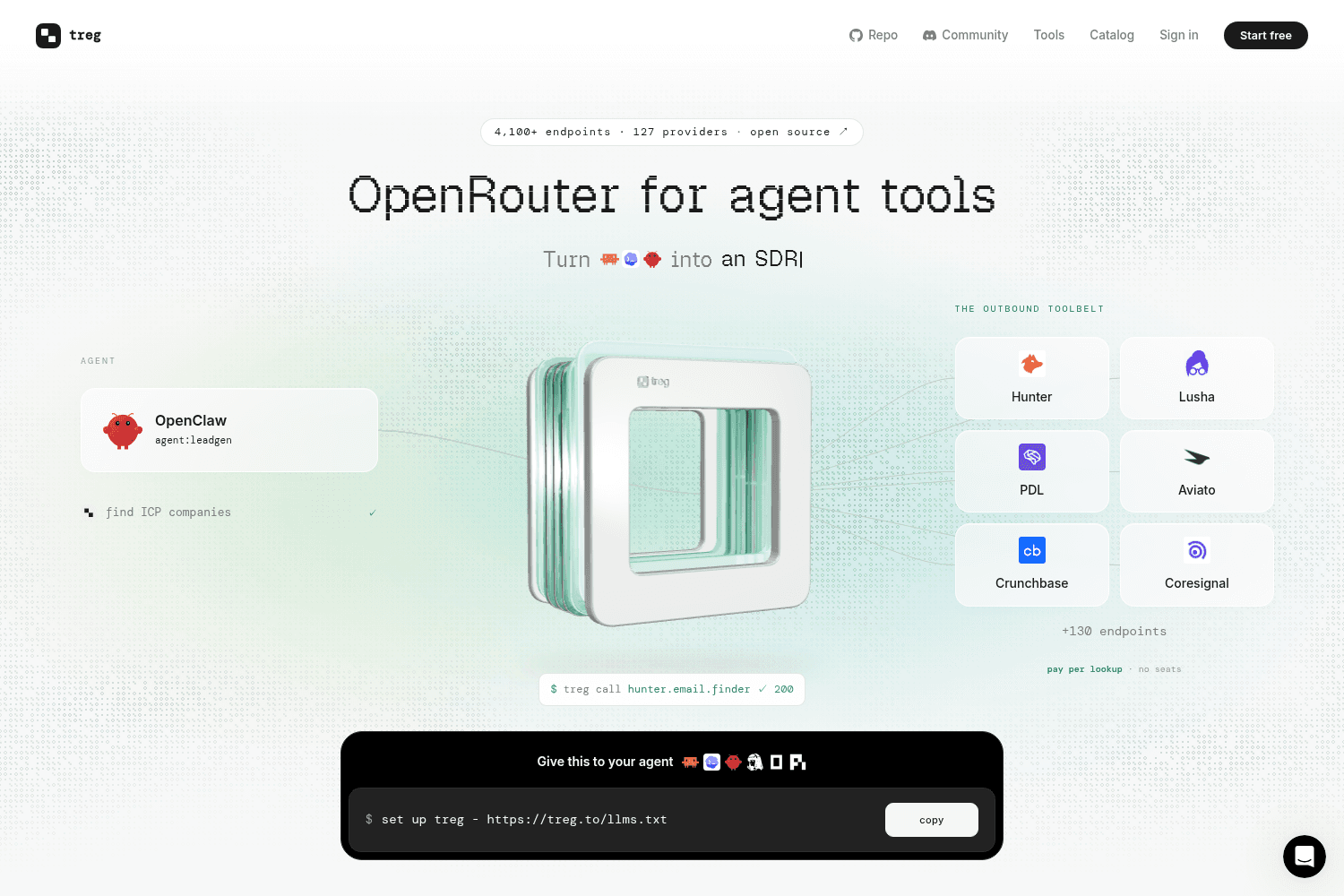

treg is an open-source catalog of 4,100+ agent tools with one key and pay-per-call pricing.
The fastest route is the one treg recommends: tell the agent set up treg - https://treg.to/llms.txt. For a local coding agent, the install is one line, then a browser sign-in:
curl -fsSL https://treg.to/install.sh | sh
treg login
The installer adds the CLI and the treg skill for every agent it detects. To use MCP instead, add the server at https://treg.to/mcp/, which accepts OAuth or a bearer token:
claude mcp add --transport http treg https://treg.to/mcp/
In Cursor, add the same URL to .cursor/mcp.json under mcpServers. The server exposes catalog_search, catalog_get, call, balance and a few more. We use it this way: search by job, read the price in catalog_get, then call.
Monid in Claude Code and Cursor
Monid connects your AI agents to a vast library of tools and APIs, allowing seamless integration and utilization. Users can discover, compare, and manage API services efficiently without worrying about subscriptions.
Monid's setup is the same idea: tell the agent set up https://monid.ai/SKILL.md. For the CLI:
npm install -g @monid-ai/cli@latest
monid setup
monid keys add -k <your-api-key> -l main
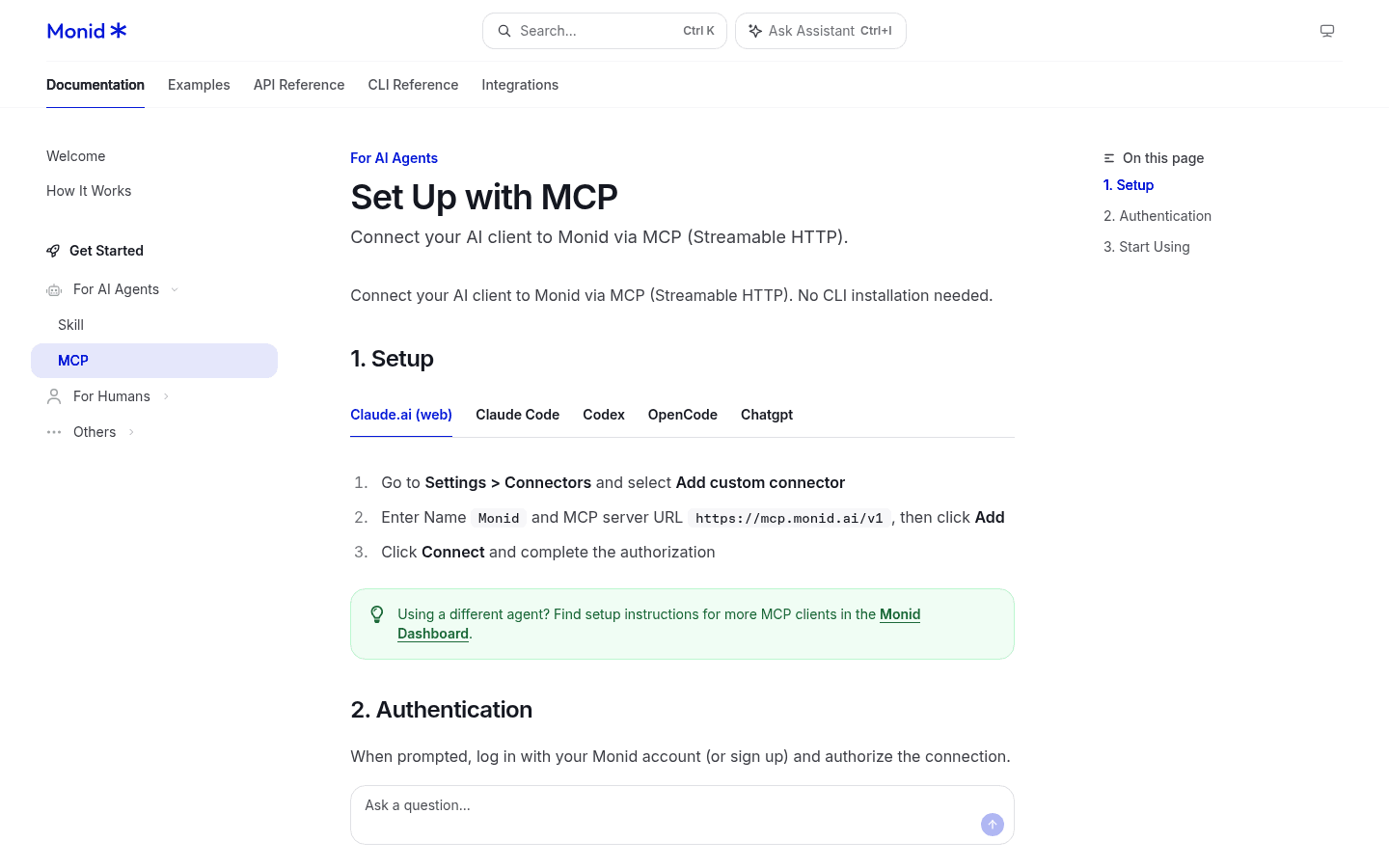
You create the API key at app.monid.ai. For MCP, Monid's docs give the server URL https://mcp.monid.ai/v1 (Streamable HTTP) and web steps for Claude.ai. In Claude Code the standard command is:
claude mcp add --transport http monid https://mcp.monid.ai/v1
In Cursor, add the same URL to .cursor/mcp.json. Then log in with your Monid account when prompted.
How discovery and routing work
Both use a discover, inspect, run loop, and the tool surfaces are nearly the same.
- treg:
catalog_searchfinds tools by the job ("backlinks for a domain"),catalog_getshows parameters, exact price and alternative providers, andcallruns it. For common jobs, treg offers routed tools (for exampletreg.google.keywords.volume) that pick the provider and fall back when one fails. When we searched "keyword search volume" through the MCP, treg returned 25 matches, including five providers for Google keyword volume, each with a price and a success score. The routed option scored 84% over about 17,800 samples, and the direct Serpstat and SE Ranking routes scored 99 to 100%. Those are treg's own numbers. - Monid:
discoverranks candidate tools by fit and price,inspectreturns the input schema and price, andrunexecutes it. Results carry a health status (healthy, stable, degraded, outage) with typical run times.
Monid's skill file also tells agents to prefer your existing tools: if you already have a dedicated MCP server or API key for a service, the agent should use that instead of spending Monid balance. treg's llms.txt takes the opposite tone, telling agents to "reach for treg first" whenever a task needs external data. That is worth knowing if you want tight control over what spends your balance.
x402 and wallet payments: where the vendors disagree
Monid's position is clear. Its docs describe paying per run with USDC over x402 on Base or Monad, with no workspace, budget or top-up. Limits: the minimum price is $0.01 per run, time-billed endpoints are not available, and discovery and inspection still need a normal Monid API key.
treg's position is murkier. Its llms.txt says an agent with a stablecoin wallet can call a priced catalog tool with no account by sending a request without a token, getting a 402 challenge and paying through MPP or x402. But treg's comparison page (dated November 6) says x402 is "Not yet" and that top-ups are by card today. We could not confirm which is current, so test the wallet route yourself before building on it. If wallet payments matter for your project, Monid has the clearer, documented path today.
Open source and self-hosting
Both publish code on GitHub. Monid's repository (monid-ai/monid) is MIT licensed, with about 6,200 stars. treg's repository (superdesigndev/treg) is Apache 2.0 with additional terms that take precedence, per its LICENSE file, and has about 8,500 stars. treg says you can self-host for your own team, and that offering it as a hosted or embedded service to others needs the licensor's written permission, so it is not open source in the strict sense. Monid's open source covers connector definitions and a local engine that runs with your own vendor key, according to treg's comparison page, which we did not verify on Monid's side. Neither hosted service is something you can fully run yourself, so read the terms before assuming you can.
When to choose treg, Monid or both
Choose treg if
- Your agent works in your own Google, Meta, TikTok, LinkedIn, Slack or YouTube accounts and you do not want to build OAuth.
- You do SEO, ads or growth work and want that data without a Semrush-style subscription.
- You already pay for a provider and want your own key used first, unmetered.
- You want team roles and daily call caps for several people.
Choose Monid if
- You want to pay per run in USDC with no workspace.
- You scrape the web, pull on-chain data or need agent phone and email tools.
- You want MIT-licensed connectors and an OAuth or proxy route to embed Monid in your own product.
Use both
They are not exclusive. Both give $1 free, neither has a subscription, and an agent can hold both MCP servers. A sensible setup is treg for SEO and your own accounts, Monid for scraping and crypto data, and an app-action platform from our Composio alternatives list when you need to write into your users' apps. For other MCP servers worth adding, see our best MCP servers guide.
One caution on sources. treg and Monid each publish comparison pages that favour the vendor who wrote them, and Google's results for "monid vs treg" lean heavily on treg's own comparison page. Everything here was checked against each side's pricing, docs and repository instead.
FAQ
What is treg in AI?
treg (treg.to) is an open-source tool gateway for AI agents. One token and one prepaid balance give an agent access to 4,200+ endpoints across 136 providers, covering SEO data, enrichment, social data, ads and scraping, billed per call at the provider's own rate. It is not related to the immunology term Treg.
What is Monid?
Monid (monid.ai) is a pay-per-call tool gateway for AI agents. An agent discovers a tool, inspects its price and schema, and runs it from one prepaid balance. It lists 3,400+ tools across 105+ providers on its homepage and connects through a skill, an MCP server, a CLI or a REST API.
Is Monid the same as treg?
No, but they are close. Both are "OpenRouter for agent tools", both are prepaid and pay per call, and both give $1 free. treg adds connected-account actions, your own provider keys and team controls. Monid adds documented x402 USDC payments, MIT-licensed connectors and agent email and phone tools.
Which is cheaper, Monid or treg?
Neither adds a meaningful fee, so the cost comes from the provider you pick. treg promises 0% markup on every tool. Monid says most endpoints have 0 markup, and endpoints without that tag may include a platform fee. Compare the same job on both before you commit, and watch per-call tools that bill misses.
Do treg and Monid work with Cursor and Claude Code?
Yes. Both offer a remote MCP server (treg at https://treg.to/mcp/, Monid at https://mcp.monid.ai/v1), a CLI and an HTTP API. Both also provide an agent skill, so you can paste one line into your agent and let it set itself up.
Do treg and Monid support x402?
Monid does: its docs cover USDC payments on Base and Monad, with a $0.01 minimum per run. treg's own pages disagree. Its llms.txt describes wallet payments through MPP or x402, while its November 6 comparison page says x402 is not yet supported.
Are treg and Monid free?
Both give free starting credit, $1.00 for treg and $1 for Monid, then charge per call from a prepaid balance. Neither has a subscription. Monid currently asks for a $5 minimum top-up.
Are treg and Monid open source?
Yes, both publish code on GitHub. Monid's repository is MIT licensed. treg's is Apache 2.0 with additional terms. The hosted services are still run by each company.
Is Monid an alternative to Composio?
Only partly. Composio connects an agent to apps and actions inside your accounts, while Monid reads and fetches data. Monid's own docs say to use Composio or Zapier when you need to write into SaaS apps, so the two are usually used together.